
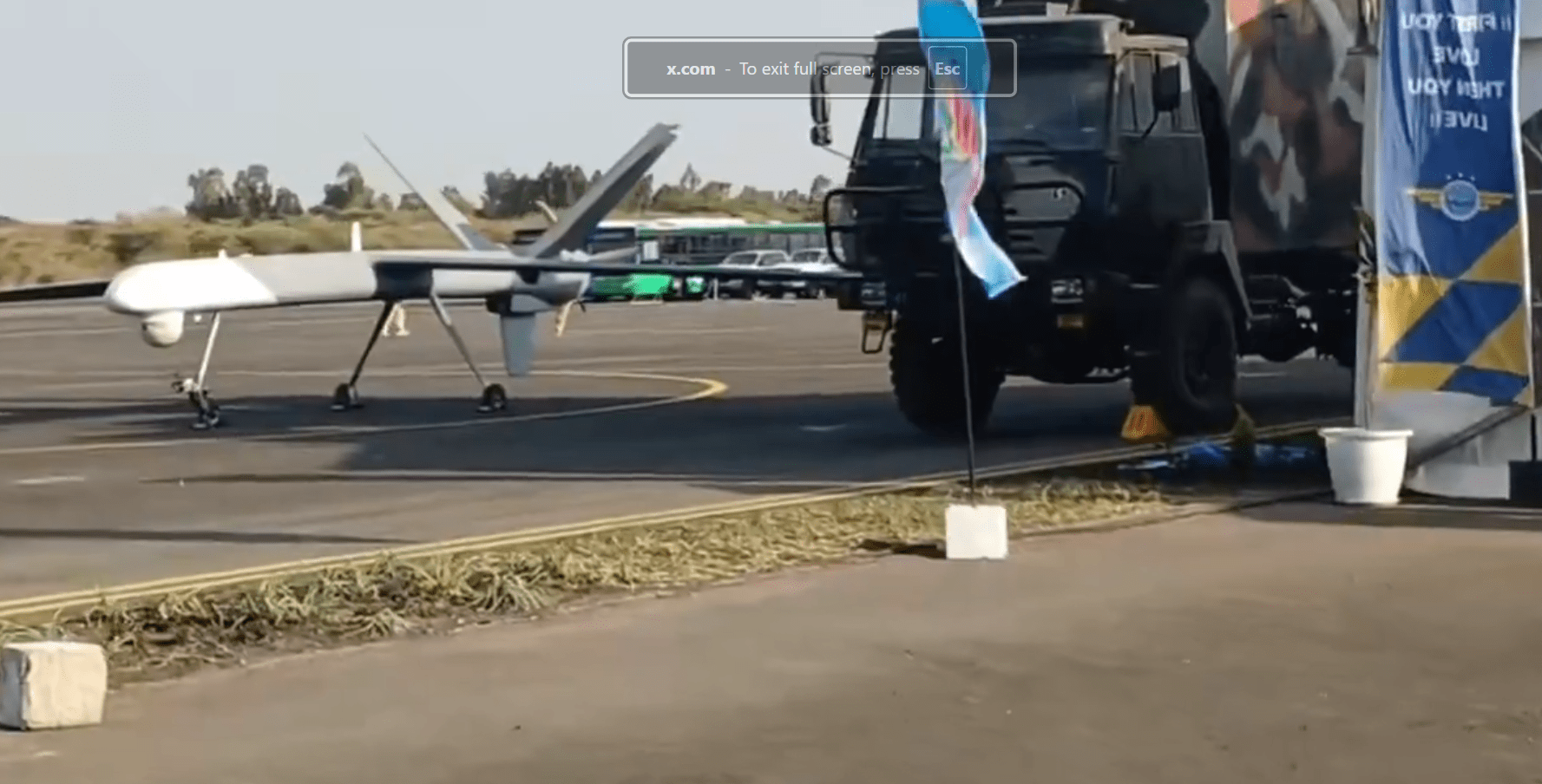
Screenshot from X
By Newz.Africa, Africa Desk | Addis Ababa, Ethiopia | 17 February 2026 | Ethiopia military drones
Claims circulating on X that Ethiopia has begun operating a Russian‑made Orion‑E MALE combat drone have sparked a sharply divided public reaction. While some users frame the development as a milestone for national defence capability, others warn that the symbolism and implications extend far beyond airspace patrols.
The post at the centre of the debate asserts that Ethiopia is the first foreign operator of the Orion‑E, now flying under Ethiopian Air Force markings. Whether fully confirmed or not, the claim has acted as a trigger for deeper arguments about security, governance, and the role of military power in a country still marked by internal conflict.
JUST IN:
— China pulse 🇨🇳 (@Eng_china5) February 16, 2026
Ethiopia became the first country to acquire the Russian Orion-E drone of the MALE SİHA (medium altitude, long endurance drone) category. pic.twitter.com/QHtv2h2a3z
Ethiopian drone capability framed as national defence
Supportive reactions present the reported drone operation as a defensive achievement. Commenters describe it as a shield for national sovereignty and deterrence against external threats. In this framing, advanced aerial capability is treated as a sign of state competence and modernisation.
This perspective reflects a broader pattern in which military hardware is used symbolically to signal control and resilience. For supporters, public acknowledgement of such capability is not reckless, but reassuring, particularly in a region shaped by instability and cross‑border tensions.
Fears of internal use dominate critical responses
A second, more critical strand of reaction interprets the same claim through the lens of domestic politics. These commenters argue that combat drones are rarely neutral tools and are more likely to be used in internal security operations than external defence.
References to civilian harm and internal targeting appear repeatedly, tying the reported drone capability to unresolved grievances from recent conflicts. In this reading, the issue is not the platform itself, but the absence of trust in how state power is exercised.
Security exposure concerns emerge alongside politics
Beyond ideological debate, a third cluster of responses focuses on operational security. These users question why details of military equipment and deployment are being shared publicly at all, warning that such disclosures could expose vulnerabilities.
This reaction is less about support or opposition to the government and more about caution. It reflects a belief that military capability should remain opaque, particularly when regional and internal tensions remain unresolved.
Russian equipment adds a geopolitical layer
The fact that the Orion‑E is Russian‑made introduces a geopolitical dimension to the debate. For some, the claim signals closer defence ties with Moscow and a diversification away from Western suppliers. For others, it reinforces concerns about alignment choices and the political costs that can accompany them.
As a result, the discussion shifts easily from drones to diplomacy, with the platform becoming a proxy for arguments about Ethiopia’s international positioning.
Why this debate escalated so quickly
The intensity of the reaction is driven less by the technical details of the drone and more by what it represents. Military hardware, especially unmanned aerial systems, carries strong symbolic weight. It can be read simultaneously as protection, intimidation, progress, or threat.
In Ethiopia’s case, that symbolism is amplified by recent history. Any assertion of expanded military capability is inevitably filtered through memories of internal conflict, making consensus almost impossible.
What the reaction reveals
The online response shows a society deeply divided on the meaning of security. One side equates strength with safety. Another equates it with risk. A third worries about transparency itself.
What unites all three is an understanding that drones are not just machines. They are political instruments, and public discussion about them is never neutral.
About the Author


