
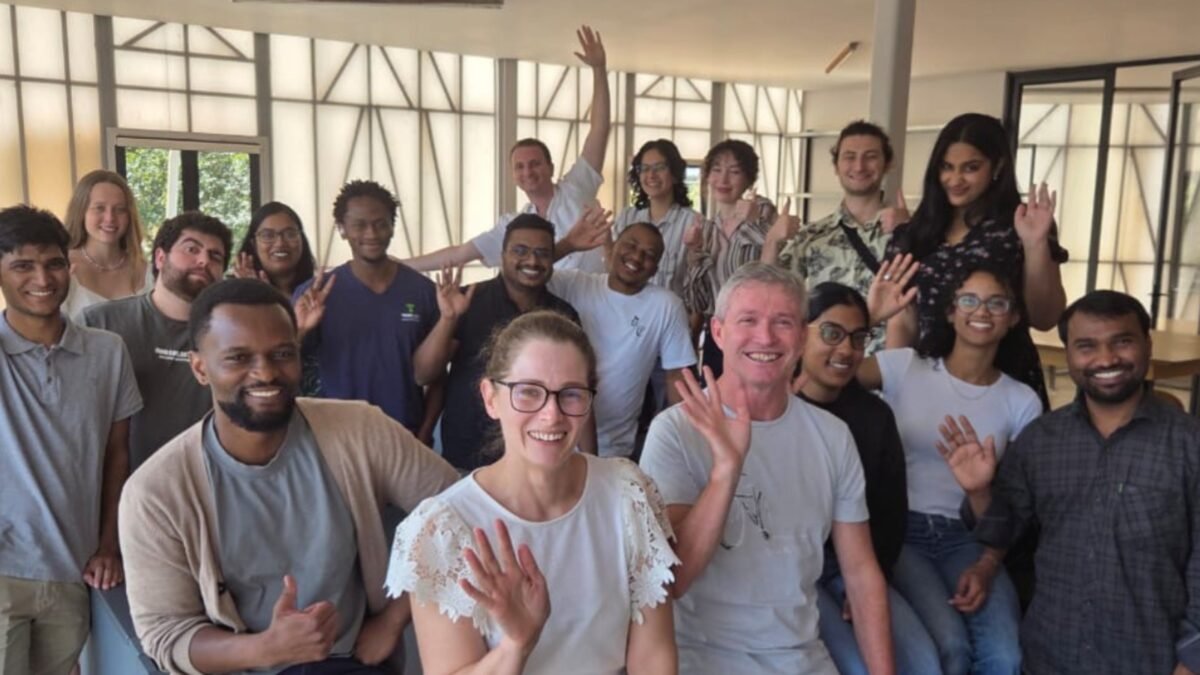
Photo by @pmcafrica via X
Newz.Africa News Desk | 15 April 2026 | Johannesburg, South Africa | Quantum Internet SouthAfrica
A University of the Witwatersrand physicist, Professor Andrew Forbes, is leading research into a quantum internet system. This system could transmit data at speeds far beyond current fibre networks. Using lasers and single photons, the project promises both unprecedented speed and unbreakable security. Furthermore, it is formally recognised through Wits University’s physics department and the South African Quantum Technology Initiative (SA QuTI).
What’s Happening
According to Gadget, Professor Forbes and his team are developing photon‑based transmission methods. In these methods, single photons act as both carriers of information and encryption keys. Consequently, this approach allows data to move thousands or even millions of times faster than conventional fibre‑optic systems. Moreover, any interception attempt is immediately detectable.
In his own words, Forbes has described the work as “bending light to our will so that it can carry information securely and at speeds we have never seen before.”
In his own words, Forbes has described the work as “bending light to our will so that it can carry information securely and at speeds we have never seen before.”
Newz.Africa Analysis
The initiative positions South Africa as a contender in the global race to develop quantum internet infrastructure. If successful, it could transform secure industries such as banking, defence, and government communications. In particular, it would do so by introducing encryption that cannot be broken with classical computing. Economically, the local quantum communication sector is projected to reach R911 million by 2030. As a result, it will offer new opportunities for investment and innovation.
Elon Musk has publicly criticised South Africa’s licensing framework, contrasting sharply with Forbes’s sovereign infrastructure ambitions. In a pinned post on X, Musk stated:
“South Africa won’t allow Starlink to be licensed, even though I was born there, simply because I am not black. We were offered many times the opportunity to bribe our way to a license by pretending that a black guy runs Starlink SA, but I have refused to do so on principle.” He has also described B‑BBEE rules as “openly racist” and claimed they blocked Starlink’s rollout despite offers to provide free internet to schools.
This divergence highlights two competing visions. Musk’s Starlink focuses on consumer access in rural areas, while Forbes’s quantum internet targets sovereign infrastructure with vastly higher speeds and security. Moreover, experts in the field of quantum communication argue that South Africa’s approach could “leapfrog consumer‑focused solutions and establish itself as a leader in secure, high‑capacity networks,” provided the necessary investment and policy support are secured.
Challenges remain. Quantum hardware is expensive and not yet mass‑produced. Scaling from laboratory experiments to nationwide deployment will require significant investment. In addition, government policy support will be critical to integrate quantum networks into existing fibre infrastructure. International competition is intense. With Europe, the United States, and China advancing their own programmes. South Africa’s next steps will involve pilot projects, securing funding. Expanding SA QuTI’s collaborations with global research partners.
South Africa’s quantum internet project, led by Professor Andrew Forbes, represents more than a scientific breakthrough; it is a statement about the country’s capacity to shape its own digital future. While Elon Musk’s Starlink has sparked controversy over licensing and access, Forbes’s work points to a sovereign infrastructure model built on speed, security, and innovation.
The coming years will determine whether South Africa can secure the investment, policy support, and technical scale required. These factors are necessary to turn laboratory success into national deployment. If achieved, the country could stand at the forefront of global quantum communication. Furthermore, it would set a precedent for how emerging economies harness cutting‑edge science to redefine connectivity.
Original Reporting
Newz.Africa reviewed official statements from the University of the Witwatersrand on quantum photonics research and the South African Quantum Technology Initiative’s flagship programme on quantum communication.
About the Author


