
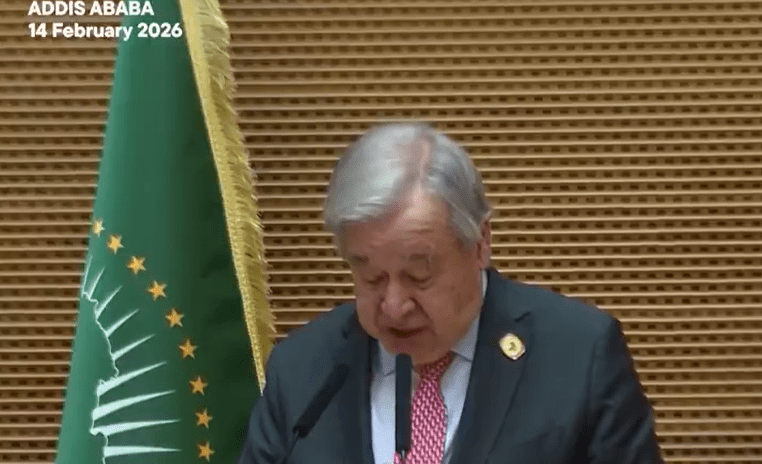
Screenshot from UN Spokesperson video via X
Africa Desk | Addis Ababa | Ethiopia | 18 February 2026 | UN Security Council
Public debate over Africa’s role in the United Nations Security Council has intensified, with voices online questioning both the absence of permanent African seats and the broader veto system itself. Commentators have argued that those most affected by inequality and climate change should have greater influence in shaping global decisions, while others warned that representation without real power risks being symbolic.
The absence of permanent African seats in the Security Council is indefensible.
— UN Spokesperson (@UN_Spokesperson) February 16, 2026
This is 2026 — not 1946.
-@antonioguterres at the @_AfricanUnion Summit in Addis Ababa. pic.twitter.com/T3XdlmriDJ
Some posts went further, calling the veto system unjust and pointing to repeated U.S. vetoes on resolutions concerning Israel. Against this backdrop of public frustration, the UN Spokesperson’s remarks in Addis Ababa declaring Africa’s exclusion “indefensible” have added momentum to a conversation that blends demands for inclusion with calls for structural reform.
Public voices on UN Security Council
Debate over Africa’s role in global governance intensified after a series of public reactions questioned both representation and the veto system. Jon Wiltshire argued that those most affected by inequality, climate change, hunger, and lack of stable education and healthcare should have the greatest say in shaping their future. Sam added that a seat without influence risks being symbolic, stressing that representation must translate into meaningful change. Dilshad Sharif went further, describing permanent seats and veto power as unjust, citing repeated U.S. vetoes on resolutions concerning Israel.
Other commentators expressed skepticism about Africa’s capacity to provide security. GenXer questioned whether any country in sub‑Saharan Africa could offer stability. Patrick Holleran responded by focusing on the veto itself, warning that adding another veto would not solve the harm caused by the existing five. His post included an image declaring that “The Problem With The Earth Is UN VETO,” underscoring frustration with the system.
UN Security Council reform in Addis Ababa
The debate coincided with remarks delivered at the African Union Summit in Addis Ababa. The UN Spokesperson highlighted a decade of cooperation with Africa, including frameworks on peace and security, sustainable development, and human rights. The statement referenced collaboration during COVID‑19, partnerships on silencing the guns, and the adoption of Security Council Resolution 2719, which created predictable funding for EU‑led peace support operations.
The spokesperson acknowledged Africa’s leadership in global justice demands, including calls for reparatory frameworks addressing slavery and colonialism, as well as climate ambition and reforms to the global financial architecture. The speech culminated with a direct critique:
“The absence of permanent African seats in the Security Council is indefensible. This is 2026, not 1946.”
Security Council debate and African demands
The combination of official remarks and public commentary illustrates the layered nature of the debate. While the UN statement framed Africa’s absence as outdated, public voices questioned whether adding seats would be sufficient without addressing veto power. Some emphasized legitimacy through inclusion, while others insisted that structural reform must dismantle the veto system itself.
The discussion reflects Africa’s growing role in shaping global governance debates. Whether reform takes the form of permanent seats, veto abolition, or broader restructuring, the issue remains central to Africa’s demand for equity in international decision‑making.
About the Author


