
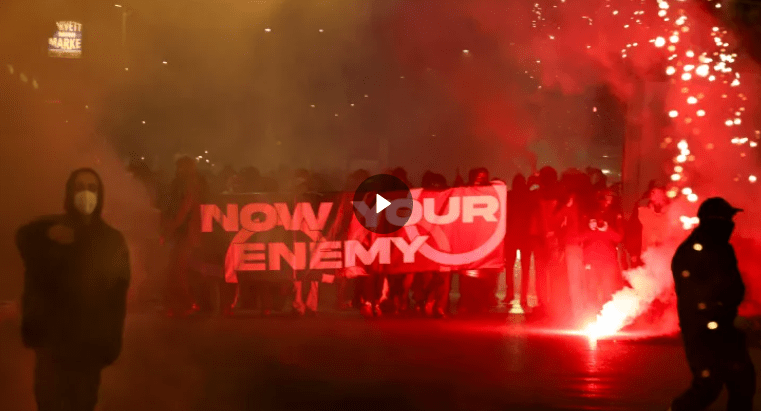
Sceenshot from Al Jazeera
By Newz.Africa News Desk | Milan, Italy | 8 February 2026 | Winter Olympics protests Italy
Protests have surged across Italy as thousands marched against the Winter Olympics in Milan. Demonstrators targeted Israel’s participation, the deployment of US ICE agents, and the environmental and social impacts of the Games. Reports confirm that smoke bombs and firecrackers were used before police responded with tear gas and water cannons.
Italian leaders also condemned the unrest. Prime Minister Giorgia Meloni referred to violent protesters as “enemies of Italy and Italians,” noting that sabotage of railway cables near Bologna had triggered investigations linked to terrorism. Police said tens of thousands joined various rallies across Olympic venues, raising concerns about security on the first full day of events.
Public anger grows over Israel and ICE involvement
Alongside environmental concerns, public outrage focused heavily on Israel’s inclusion. Protesters raised Palestinian flags and voiced anger over human‑rights violations. The games’ opening ceremony saw Israel’s delegation greeted with boos from sections of the crowd.
Protests have erupted in Italy against the Winter Olympics, with thousands marching to condemn Israel’s participation, the presence of ICE agents with the US delegation, and the event’s environmental and social impact. pic.twitter.com/N9riThLxqt
— Al Jazeera English (@AJEnglish) February 8, 2026
Opposition to the presence of US ICE agents was equally fierce. Reports show ICE officers were deployed to support security for the US delegation, despite reassurances that they would not conduct immigration enforcement in Italy. This did little to calm protesters who linked ICE to abuses in US cities, particularly Minneapolis.
Winter Olympics protests Italy fuel wider political frustration
Public commentary shows deep frustration that extends far beyond the Games themselves. One user criticised the West for banning Russia yet embracing Israel and bringing ICE agents along. Others said the Olympics are no longer a unifying event but a stage for global grievances.

Some argued that the Games reflect a wider collision of politics, identity, and global injustice. Many described the protests as a symptom of a broken “Olympic spirit,” weighed down by political baggage and public anger.
Several users accused world leaders of ignoring mass casualties and genocide. Others highlighted broader systemic failures, arguing that society is increasingly aware of global suffering and refusing to stay silent.
Questions raised over US presence and policing
Commenters also questioned why ICE agents were present at all. Many asked what purpose they served, given that they are not conducting immigration enforcement abroad. Others expressed distrust of the Olympics as an institution. Some described the event as corrupt or outdated. A minority responded with humour, downplaying the tension.
The reaction online shows strong disagreement about the legitimacy of the Games and the role of global powers in shaping them.
Original reporting
Comments from users reveal several key themes:
- anger at double standards in global politics
- frustration over Israel’s participation
- condemnation of ICE involvement
- concern over environmental destruction
- criticism of Olympic institutions
- calls for accountability from global leaders
- emotional responses referencing global suffering
The sentiment ranges from political critique to despair, anger, and moral outrage.
Primary artefact
What’s unfolding in Italy around the Winter Olympics is less about sport and more about the collision of global politics, identity, and public frustration spilling into a space that was once meant to unify.
— Ssebagala Nuuh🇺🇬 (@NuuhSsebagala) February 8, 2026
On one level, these protests reflect a broader trend: international…
Public comments reflect:
- claims of hypocrisy in Western foreign policy
- criticism of global leaders
- frustration about human‑rights violations
- comments condemning the Games as corrupt
- questions about ICE’s role
- calls for justice for oppressed communities
These comments show broad public dissatisfaction that cuts across political and regional lines.
Also Read:
About the Author


