
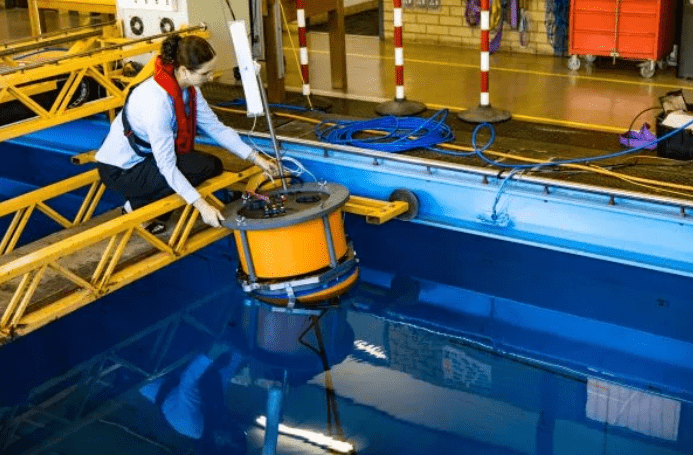
Photo by CSIR
Newz.Africa, News Desk | 21 April 2026 | South Africa | underwater sonar data transmission
South African researchers have developed a wireless underwater communication system capable of transmitting sonar images to the surface with minimal delay. The work is being led by the Council for Scientific and Industrial Research (CSIR) and focuses on improving real-time data exchange in marine environments.
The development matters as industries such as offshore energy, maritime security and ocean research rely on timely and accurate underwater data to guide operations and decision-making.
What’s Happening
The CSIR confirmed in a March 2026 statement that its researchers are advancing a system designed to transmit high-resolution sonar images from underwater vehicles to surface vessels more efficiently (CSIR, 2026).
The technology combines broadband acoustic communication with synthetic aperture sonar capabilities. According to the CSIR, the system enables unmanned underwater vehicles to send detailed imaging data without relying on physical retrieval or slow transfer methods.
This reduces delays between data capture and analysis, which is critical in environments where conditions can change rapidly. The communication method uses acoustic signals to transmit data through water, where traditional radio frequency signals are ineffective.
The CSIR further noted that earlier iterations of the technology demonstrated data transmission speeds exceeding 200 kilobits per second under test conditions (CSIR, 2022).
Researchers indicated that the system is designed to support applications including seabed mapping, infrastructure inspection and environmental monitoring. The integration of sonar imaging with real-time communication allows operators to assess underwater conditions while missions are still in progress (CSIR, 2026).
Newz.Africa Analysis
The development signals a shift in how underwater operations may be conducted across multiple sectors. Faster transmission of sonar data reduces reliance on delayed post-mission analysis and allows for more responsive decision-making during deployments.
In offshore industries, real-time imaging could improve inspection of subsea infrastructure such as pipelines and cables. This may support earlier detection of faults and reduce operational risks.
In maritime security, faster sonar data transmission could strengthen monitoring capabilities in territorial waters. For scientific research, near real-time data flow may enable more adaptive mission planning and data-driven adjustments during fieldwork.
However, underwater communication remains constrained by signal attenuation, interference and limited bandwidth. While the reported transmission speeds represent progress, further validation will determine how the system performs in varied ocean conditions and at operational scale.
The CSIR’s work positions South Africa within a specialised field of underwater communication and sensing technologies, with potential implications for both commercial and research applications.
In operational terms, the CSIR’s system represents a measured step towards more responsive and data-led underwater activity. If validated at scale, it could support faster decision cycles across research, infrastructure monitoring and maritime operations. The next phase will depend on sustained testing in real-world conditions and alignment with industry use cases. Outcomes from these stages will determine how quickly the technology moves from controlled environments into routine deployment.
Original reporting: Newz.Africa reviewed the CSIR media release published in March 2026 and supporting CSIR technical material on underwater acoustic communication systems. No additional institutional comment was received before publication.
About the Author


