
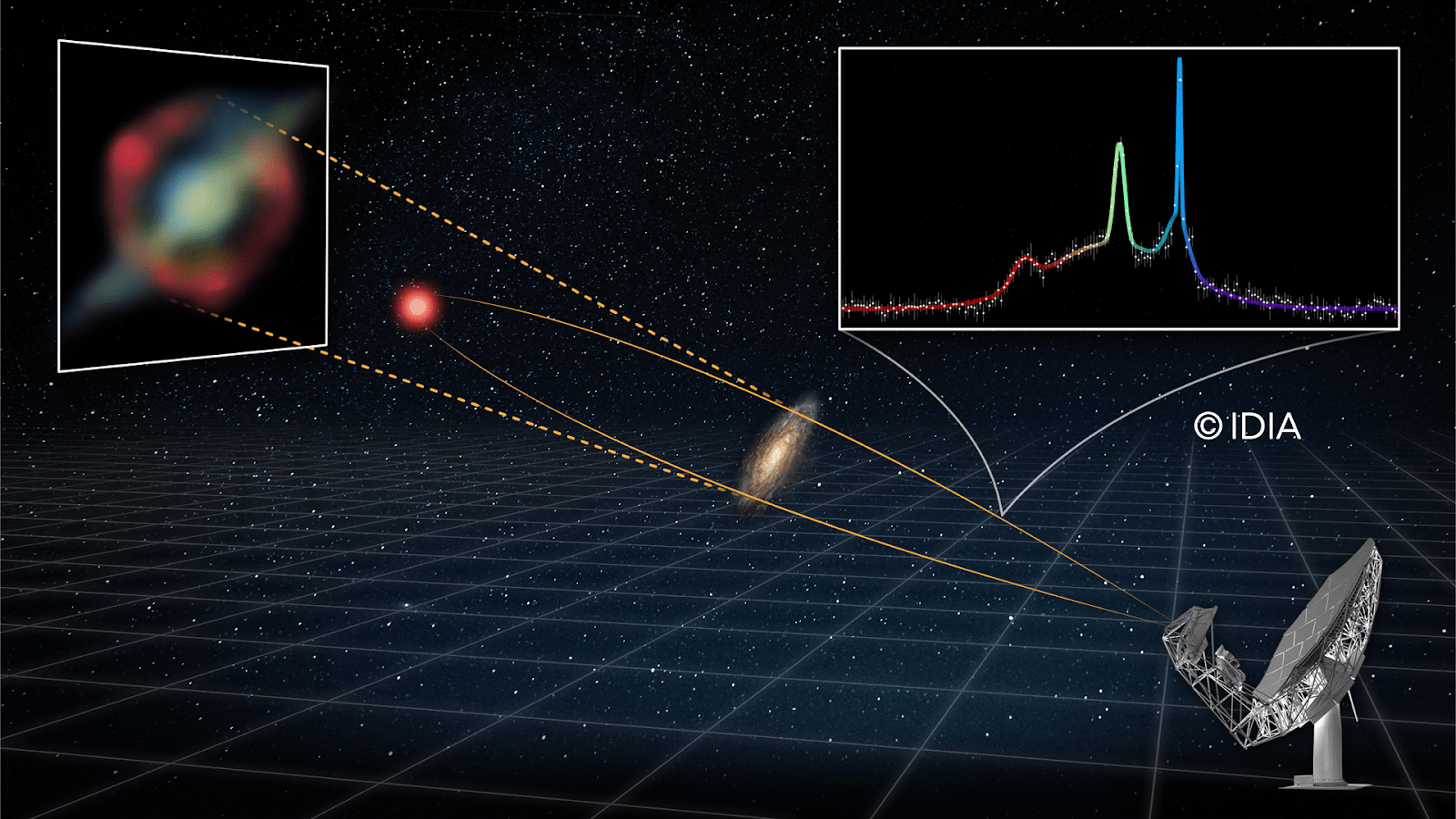
Photo by ©IDIA VIA MeerKat Press release
By Newz.Africa News Desk | Cape Town | Karoo | 24 February 2026 | radio laser
South Africans online have reacted with humour and scepticism after hearing that researchers detected a cosmic radio laser more than eight billion light years away.
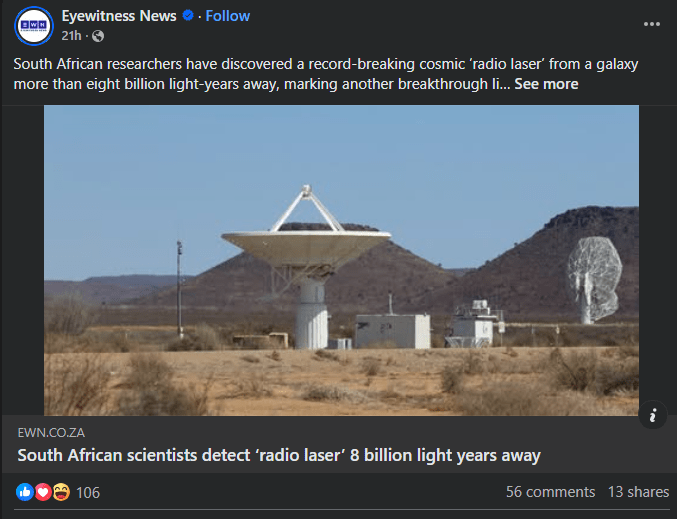
EddieTiffany Grobler wrote, “Really, then why do I struggle with wifi signal 80km away?” Eugene Williams commented, “Bullshithi, is it the aliens playing the golden record 😜🙄.
Nico van der Merwe added, “So if they are aliens they had Laser Radio 8 billion years ago… wonder what they are playing today, if they are not extinct.”
These voices show how scientific discoveries are often met with jokes, disbelief and imagination in public spaces.
Facts from South Africa
The radio laser, known in astronomy as a megamaser, was detected using the MeerKAT radio telescope in the Karoo. A megamaser is a very strong beam of radio waves that forms when galaxies collide and release huge amounts of energy. The detection is record breaking because of its extreme distance. It gives scientists a rare chance to study galaxy collisions and the early universe. The MeerKAT telescope has already produced several important findings and this adds to its growing reputation in global astronomy.
Radio laser reactions
The online comments highlight how people connect scientific news to everyday life. The Wi‑Fi remark shows frustration with local technology compared to the scale of cosmic research. The alien jokes reflect scepticism and a playful way of dealing with complex science. The speculation about extraterrestrials shows how discoveries often spark imagination. These reactions do not confirm wider public opinion but they illustrate how South Africans engage with astronomy news in social media spaces.
Newz.Africa in depth analysis
The radio laser discovery is a technical achievement that places South Africa at the centre of global astronomy. The MeerKAT telescope is part of a long term plan to build scientific capacity in the country and to contribute to international projects. Detecting a megamaser at such a distance helps researchers understand how galaxies formed and how the universe evolved. It also shows that South African science can produce results that are recognised worldwide.
The public reaction is important because it shows how science is received outside specialist circles. Humour and scepticism are common responses to complex discoveries. They reflect both a distance between everyday experience and advanced research, and a way of making sense of information that feels abstract. For journalists, these voices are part of the story. They show how scientific news travels through society and how people interpret it in their own terms.
The comments also raise questions about communication. Scientists and institutions often announce discoveries in technical language. Social media users respond in everyday language, with jokes and doubts. This gap can make it harder for the public to see the value of research. It also shows why science communication needs to be clear, relatable and grounded in local context.
South Africa’s role in astronomy is growing. The MeerKAT telescope is already linked to international projects and will form part of the Square Kilometre Array, the largest radio telescope in the world. Discoveries like the radio laser build scientific credibility and attract global attention. They also create opportunities for education and public engagement.
The radio laser detection is both a scientific milestone and a social moment. It shows the reach of South African research and the way people respond to science news. The humour, scepticism and imagination in public comments are part of the national conversation. They remind us that science is not only about data and instruments but also about how society understands and talks about discovery.
About the Author


