
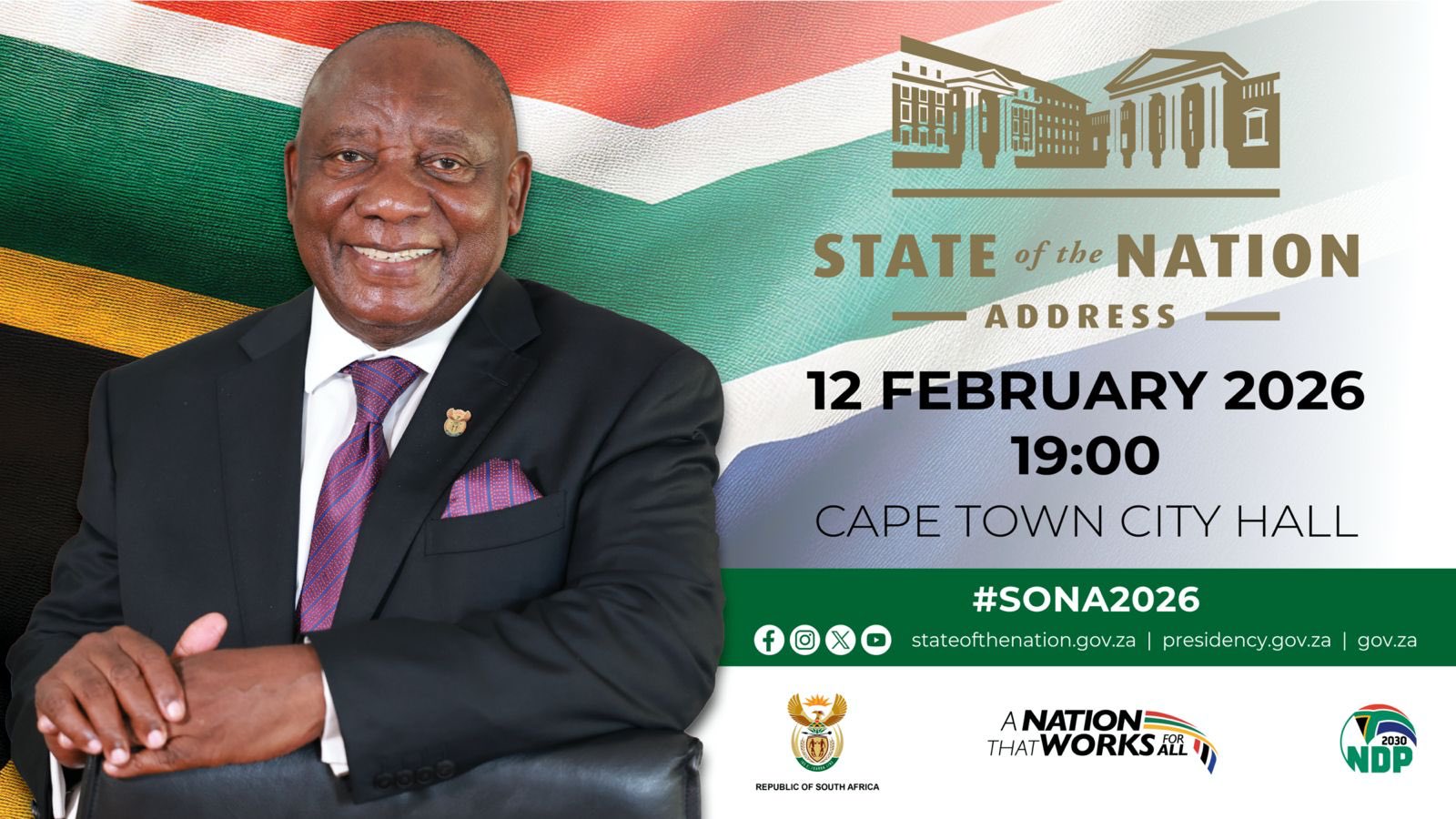
Image by SA Presidency via X
By Newz.Africa News Desk | Cape Town, South Africa | 12 February 2026 | SONA 2026 South Africa
President Cyril Ramaphosa is scheduled to deliver the 2026 State of the Nation Address on Thursday at Cape Town City Hall, addressing a joint sitting of the National Assembly and the National Council of Provinces.
The Presidency has framed the address as a moment to reflect on progress, highlight achievements, outline challenges, and set government’s policy direction for the year ahead. As with previous years, the address carries constitutional significance and symbolic weight within South Africa’s political calendar.
Public reaction to the announcement suggests that symbolism alone will not carry the moment.
Service Delivery Shapes Expectations Ahead of SONA 2026
Online responses to the official announcement have centred overwhelmingly on service delivery. Rather than speculating about policy direction or legislative priorities, commenters repeatedly referenced day‑to‑day conditions that continue to define public experience.
Water shortages, particularly in major metros, were raised frequently. Municipal infrastructure failures, deteriorating roads, inconsistent waste collection, and electricity instability also featured prominently. Healthcare access and concerns around crime and policing were cited as ongoing indicators of governance performance.
Public Tone Reflects Fatigue Rather Than Polarisation
The tone of the commentary is notable for what it lacks. There is little ideological argument, limited party‑political positioning, and minimal engagement between opposing viewpoints. Instead, the dominant mood reflects fatigue and scepticism shaped by repetition.
Several comments questioned whether language such as “progress” and “achievement” still holds meaning when set against lived experience. Others framed SONA as an accountability checkpoint rather than a moment of national inspiration.
Municipal Performance as a Measure of National Credibility
Although SONA is delivered at national level, much of the public commentary directs attention toward local government. Municipal performance has become the reference point through which national leadership is evaluated.
Persistent failures at city and community level appear to outweigh national policy framing in shaping trust. For many commenters, national plans carry limited weight without visible improvement in basic service delivery. This dynamic places pressure on the address to bridge the gap between national narrative and local implementation.
A Shift in How SONA 2026 Is Received
Previous State of the Nation Addresses have often generated sharp political contestation. The response to SONA 2026 appears different. It is quieter, more restrained, and more demanding.
The absence of overt defence or organised opposition messaging suggests a public less interested in debate and more concerned with recognition. Expectations are grounded in acknowledgment of persistent challenges rather than promises of transformation. As the address approaches, the measure of its reception is likely to rest on credibility rather than rhetoric.
Original Reporting
Newz.Africa reviewed public comments posted under The Presidency’s official X announcement of the 2026 State of the Nation Address on 11 February 2026. The majority of responses referenced service delivery failures, particularly water provision, municipal governance, healthcare access, and policing. Engagement with anticipated policy themes was minimal, indicating a shift toward outcome‑based evaluation.
Primary Artefact
Also Read
About the Author


