
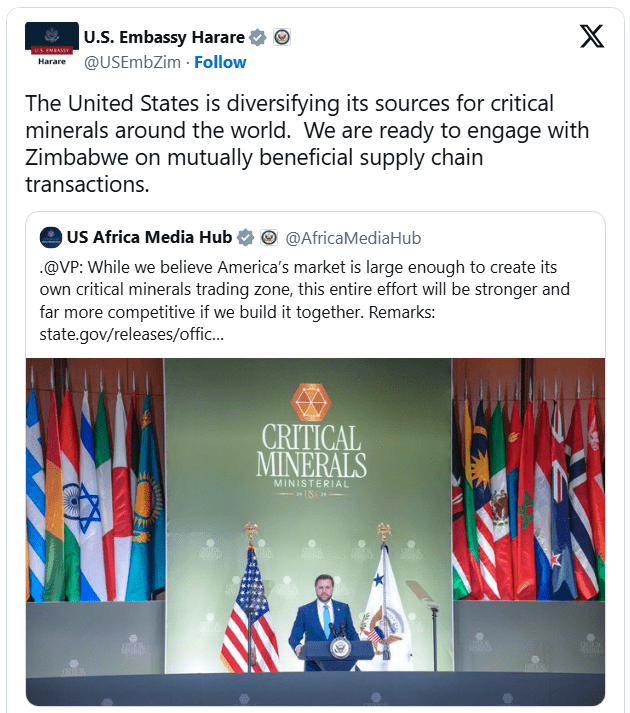
Screenshot from X
By Newz.Africa News Desk | Harare, Zimbabwe | 6 February 2026 | Zimbabwe critical minerals
Public Response to the Zimbabwe Minerals Message
The U.S. Embassy in Harare released a statement on X saying the United States is diversifying its sources of critical minerals and is ready to engage Zimbabwe. The message was framed as an invitation to explore cooperation. The public response took the discussion in a different direction. Many Zimbabweans immediately pushed back, placing sanctions at the centre of the conversation.
The comments revealed frustration. Users said the statement ignored Zimbabwe’s political experience with the United States. They argued that minerals cannot be discussed in isolation from sanctions. Others said the message felt transactional. They said the United States wants minerals without addressing the broader relationship.
The replies signalled distrust and scepticism. They did not challenge the value of minerals. They challenged the timing and tone of the embassy’s message. Many saw the outreach as incomplete, because it did not confront the issues that matter most to Zimbabweans.
Sanctions and Engagement on Critical Minerals
Sanctions dominated the reaction. A large number of users said cooperation is impossible while sanctions remain. They argued that the United States cannot speak of mutual benefit when restrictions on Zimbabwean leaders and institutions are still in place. The comments highlighted a common view that sanctions overshadow the minerals debate.
Some users framed sanctions as deliberate pressure that cannot coexist with a minerals partnership. They questioned how the United States expects trust while maintaining punitive measures. Others said the first sign of readiness would be the lifting of sanctions, not a minerals proposal.
Several comments linked sanctions to dignity and sovereignty. They said Zimbabwe must be approached as an equal partner. For many, the issue is not whether minerals can be traded. It is whether Zimbabwe is respected in the process. Until the sanctions question is settled, minerals discussions feel premature to the public.
Trade Access, Fairness and Zimbabwe’s Minerals
Another key theme was trade access. Many users said Zimbabwe must be included in AGOA before any minerals engagement begins. They argued that fair access to the U.S. market is a measure of goodwill. Without it, the embassy message appears selective. Users said they do not want a minerals-only relationship. They want balanced trade.
Several comments also questioned the United States’ motives. Some suggested that the timing reflects global competition for minerals like lithium. They said the United States wants to diversify because other countries are strengthening their positions. This created suspicion about whether the outreach is driven by partnership or resource security.
Many users said AGOA would demonstrate sincerity. They said Zimbabwe cannot engage meaningfully without trade privileges that other African countries enjoy.
Their view was simple. If the United States wants access to Zimbabwe’s minerals, it must also open access to its own markets.
Eastern Partnerships and the Minerals Landscape
A portion of users highlighted Zimbabwe’s existing relationships with China. They said Zimbabwe already works with partners who have been consistent and present for years. They felt that China treats Zimbabwe as a partner without conditionalities. This comparison created pushback against the U.S. message.
Some comments said the United States is not Zimbabwe’s first choice for minerals cooperation. Others said the country is not desperate. They argued that Zimbabwe can choose partners who respect its sovereignty and economic priorities.
The comments also pointed out that Zimbabwe has options. The minerals sector is competitive. Zimbabweans believe they can negotiate from a position of strength, not weakness. This shapes how they interpret offers from Western governments.
Sovereignty, Trust and Public Sentiment
Sovereignty appeared repeatedly in the replies. Users said Zimbabwe wants partners who recognise its independence. They said minerals cannot be the starting point. Trust comes first. Respect comes first. Political fairness comes first.
The embassy message did not address these concerns. As a result, many users felt the statement did not speak to Zimbabwe’s real priorities. They viewed it as a technical offer without political context. For them, the minerals issue is tied to national identity, dignity and international alignment.
The overall public sentiment was firm. Zimbabweans are open to cooperation. They are not open to bypassing the issues that matter most to them. Sanctions, AGOA access, trust and sovereignty shape how they evaluate any minerals conversation.
Original Reporting
This article is based on direct analysis of public comments posted under the U.S. Embassy Harare’s official statement on X. Screenshots provided by the user were used to examine public sentiment in detail.

Primary Artefact
The original U.S. Embassy Harare statement and accompanying public comments, provided via user screenshots.
The United States is diversifying its sources for critical minerals around the world. We are ready to engage with Zimbabwe on mutually beneficial supply chain transactions. https://t.co/rgg42gvNWu
— U.S. Embassy Harare (@USEmbZim) February 6, 2026
Also Read
About the Author


